
Learning to Talk to Trees
I’m walking to collect the mail at the end of our driveway when I hear a voice high above me.
“Ali! Ali! I’m stuck and I can’t get down!”
I look around, bewildered, then spot my big brother near the top of the 80-foot Eastern white pine in our yard. An hour earlier, he’d jumped to the lowest branch and spiraled his way up.
I run to get Mom. “Scott needs help! Call a fire truck!”
Instead, my mom stands calmly beneath him, calling out which branch to take, step by step. I watch in amazement as he safely makes his way down to the ground with mom guiding him.
Seven years later, I’m in a sterile hospital room. A bulletin board is plastered with photos and inspirational words for my 21-year-old big brother. He has been in a coma for four months. We make the 40-minute drive every day to be by his side. He still has a feeding tube, though his tracheotomy has been removed.
His front tire blew while he was driving on a winding road where he was at school. He suffered a serious brain injury and was airlifted to a trauma center.
We sit by his bed, hold his hand, stroke his face, tell him how dearly he is loved. I run my hand through his thick brown waves and assure him that he’s never going to go bald. My little sister draws him pictures.
Every day, I write to him in a journal we keep on the bedside table.
“Hi Scott, today we thought you raised your eyebrow while we were telling you about all the things we are going to do together, like body surf, play piano, get another parakeet—when you get better. Get better, Scott—please come back.”
My mom, my 12-year-old sister and I are in this together. We don’t want a day to pass without him feeling us there. On some level, we just know he can sense our presence, our love.
My mom is wise; she can sense that we’re burning out at this pace. When the staff come in to give him a sponge bath or take his vitals, she declares:
“Time to get some fresh air and go find a tree.”
We’re in Center City Philadelphia, surrounded by metal buildings, brick houses, and cement sidewalks, with barely any greenery in sight. Still, my mother insists we walk out into the summer humidity and find the closest tree.
I don’t remember the tree itself—only that it was hemmed in by concrete and wasn’t particularly notable. I’m pretty sure it was too small to hug. My mom puts her hand on the bark.
“This is how we ground ourselves,” she says. “This is how we reset when we’re out of sorts.”
Sometimes she presses her forehead against it and talks, as if she’s praying, pleading, talking to God. This is where I learn to talk to trees, to pour out my problems and reach for their bark when I’m distressed.
After twenty minutes, we go back inside to sit with my unresponsive brother. The next day, we do it again.
Over the course of many months, my brother slowly woke. His injuries would change the course of his life. He eventually moved into a group home for people with brain injuries, where he continues to rehabilitate his brain and body.
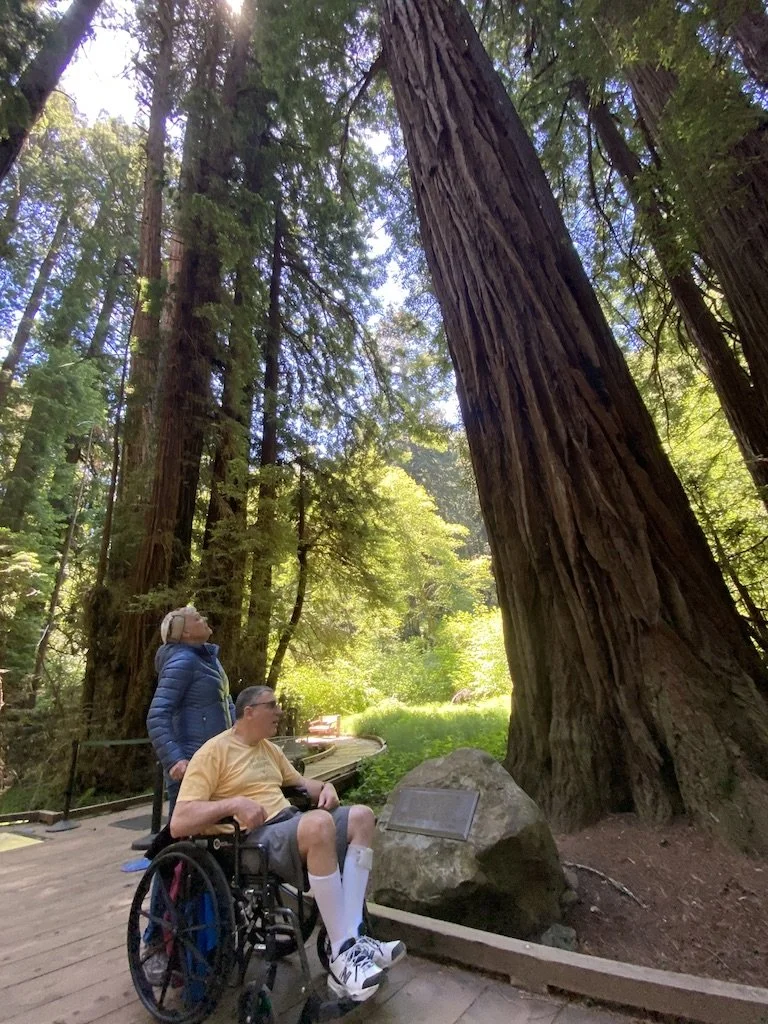
My brother and mom at Muir Woods
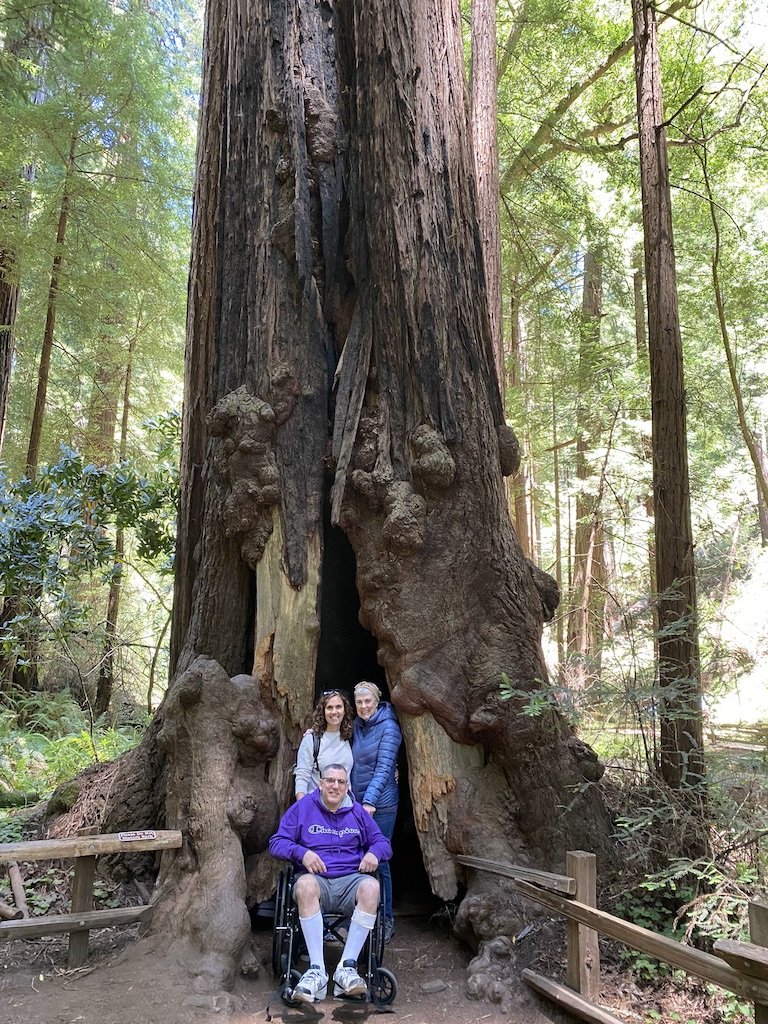
My mom, brother & I at Muir Woods
I married, moved to California, and bought a house in a redwood forest. Now I’m bathed in trees, with plenty to touch and talk to each day. After years of walking the same trails near my home, I have tree friends of my own.
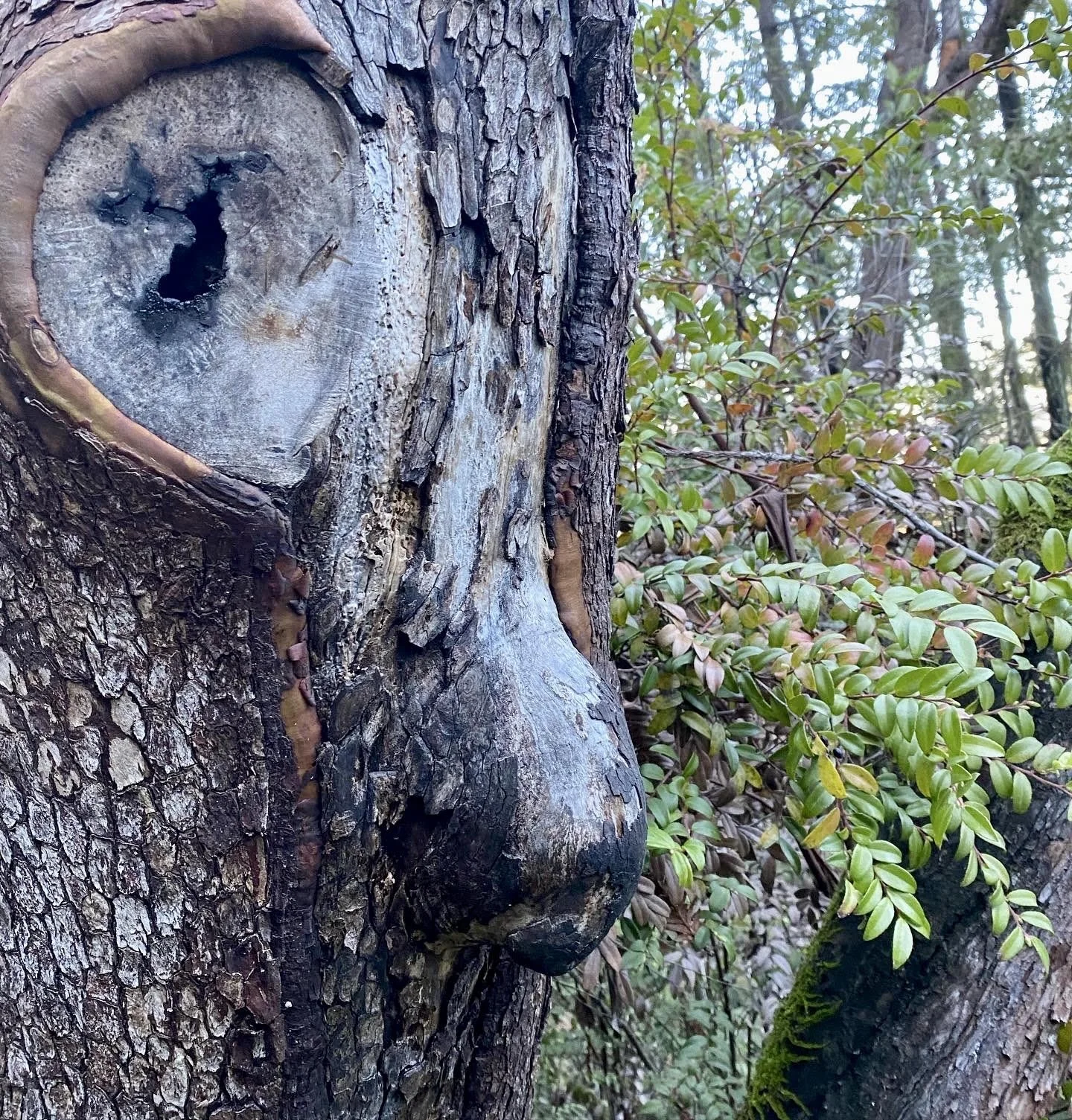
There’s Hank, the madrone with eyes and a nose. Every time I pass him on Big Dog Trail, I say, “Hi Hank! Honk, honk!” I honk his nose and insist that anyone with me do the same.
There’s Lorraine, the giant Douglas fir on Huckleberry Trail. She first caught my attention by spilling sparkling clear sap down her flanks and onto the path. Now I lean against her and tuck a found feather into her bark. When a friend or family member is in crisis, we visit her. Somehow, she makes everyone feel better.
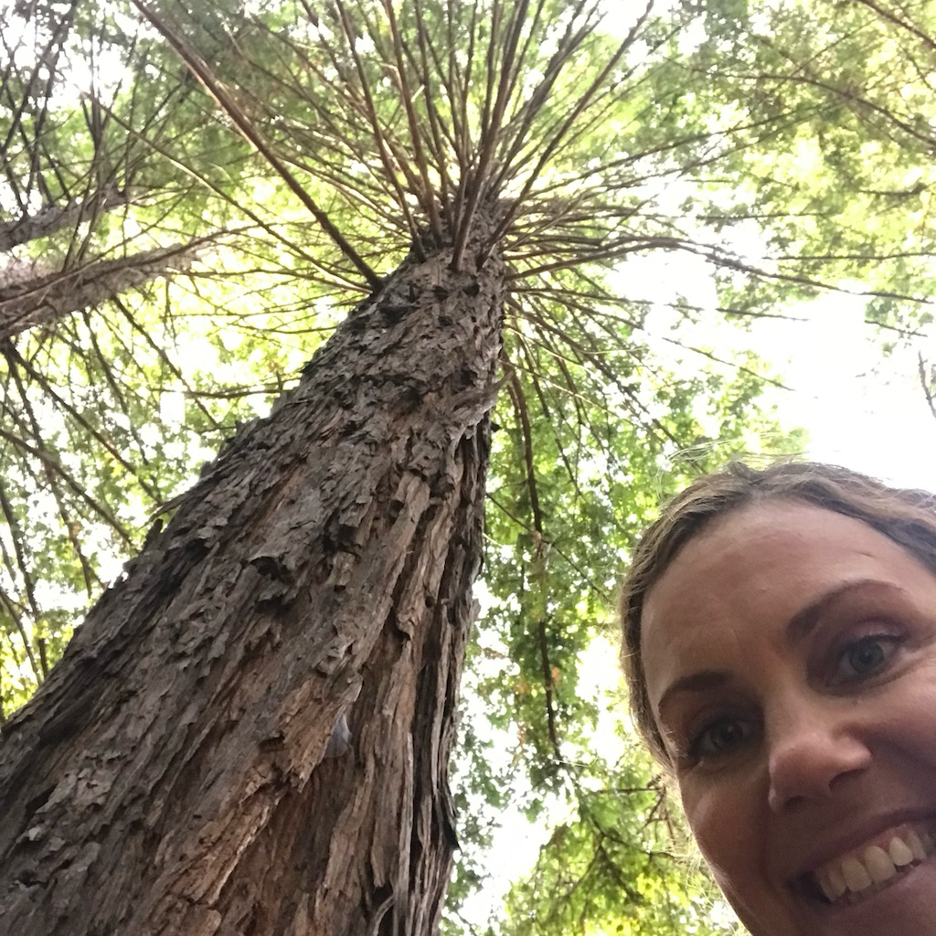
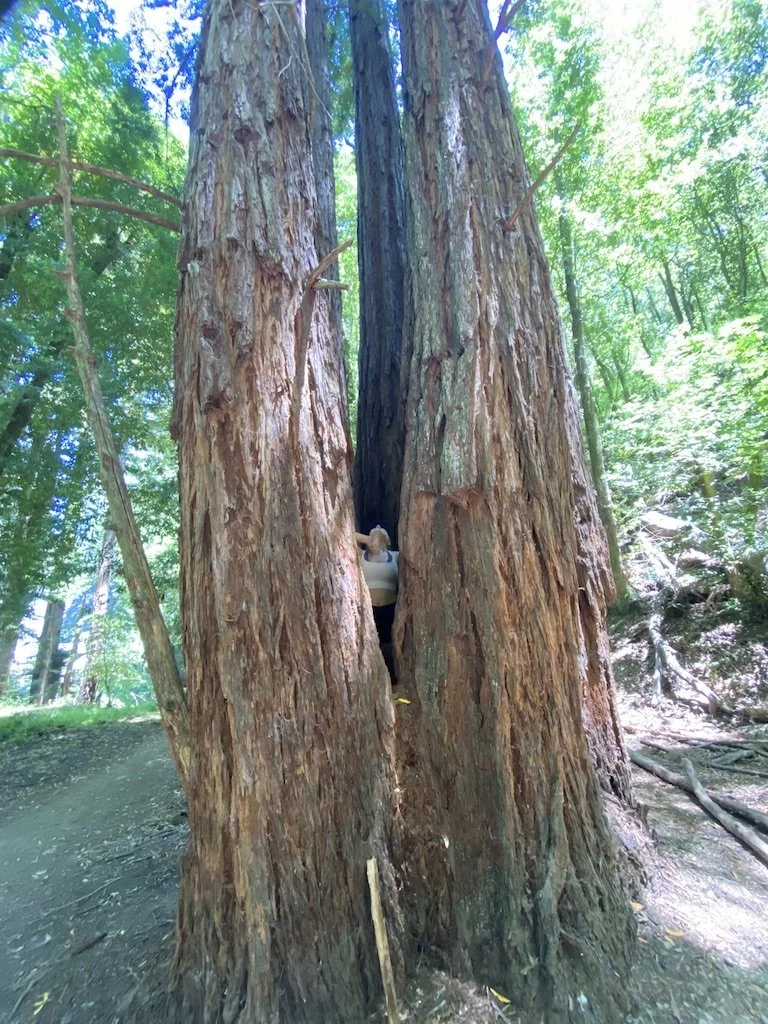
And then…there’s a special circle of redwoods in our canyon: six tall trunks rising together from one base, a tree family sharing the same root system. My kids discovered it on a hike. Most exciting was the foot-wide gap they could squish their bodies through to enter the heart of the circle. Inside, there’s room for two or three people, hidden from anyone passing by--their very own secret fort.
They proudly announced they were getting a tree hug—not giving one. The thick bark muffles the sounds outside. Standing in the center of this redwood family, you feel held and protected.
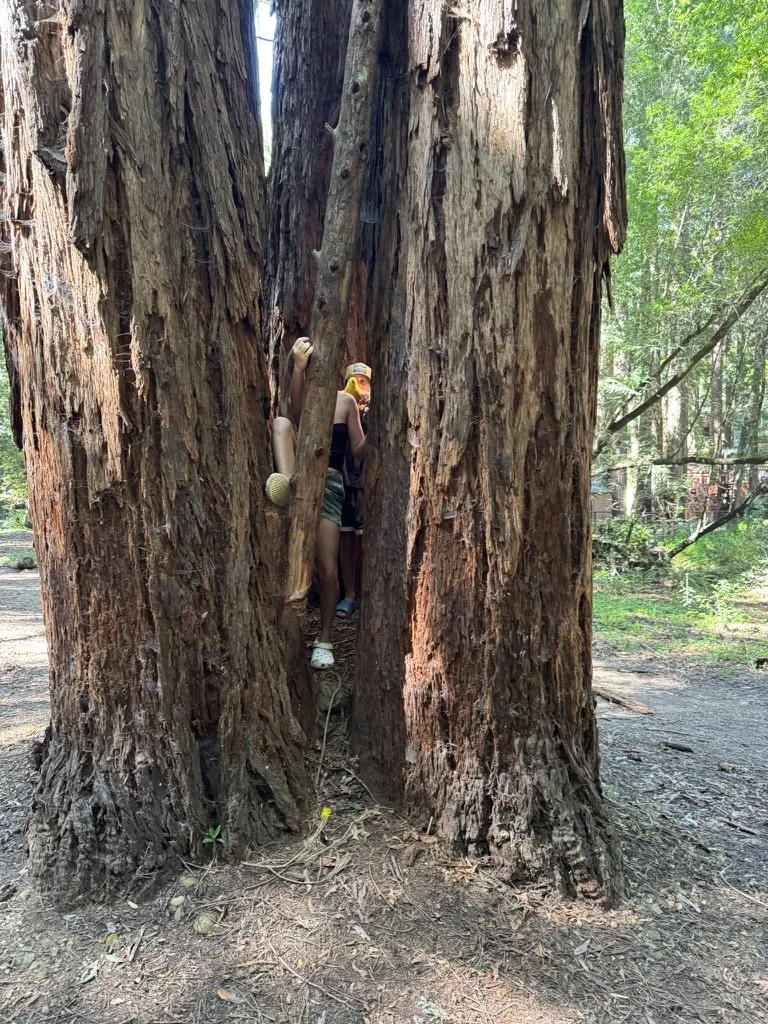
Over the years, I brought others to get a tree hug. I went there when times were tough, when I needed a place to journal or talk to God, just as my mom had taught me.
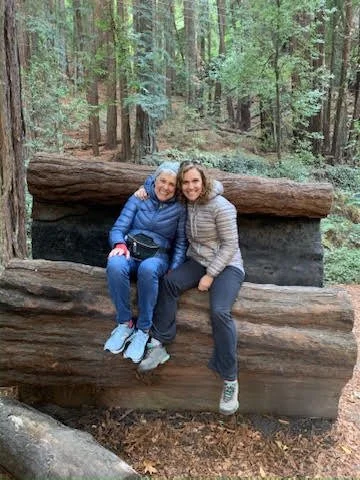
After my mother recovered from chemo and radiation, we walked the trail slowly so she could get a tree hug from these special redwoods. When she began showing signs of dementia, I brought her back again.
On the day of my mom’s funeral, my daughter and I went to our redwood family. It was cool for a May morning. We slipped inside the circle, craned our necks to look for the tops, our tears soaking into the spongy bark.
I put my hand on one tree, my daughter on another.
Writing Prompt for Your Journal:
Think of a tree that has been part of your life—one you climbed, passed every day, or sat beneath. Write about a moment beside that tree. Who were you then? What does it bring back to you now? Begin with: “There was a tree…”